LLM vs Generative AI: What to choose for your business
You have probably heard about AI many times. At every turn, you hear things like, “Your competitors have already implemented AI”, “We have automated processes in our marketing and sales departments with ChatGPT”, and “Those who don’t implement AI now will lose millions of dollars in the future”. Employees ask, “Why aren’t we using neural networks?”
So really, why not implement AI now?
However, when it comes to choosing technology, it’s very easy to get lost in the options on the market. The term AI encompasses a variety of approaches and tools, from visual generators to systems that work exclusively with text.
The most popular ones today are LLM and other examples of Generative AI. Both technologies are actively being implemented in business processes, although they solve different problems. Although what is the difference between LLM vs Generative AI and what does your business need?
The difference between these scenarios lies in the type of task and this is the key to understanding what you need.
After reading our article today, you will understand better the difference between LLM and Generative AI, which of these technologies will pay off in your business, and which will be just another trendy toy that will waste your budget and fail to deliver results.
What is LLM in Generative AI?
Are LLMs Generative AI? Technically, ChatGPT is a great example of multi-module Generative AI, and LLM is its main part, responsible for communicating with the user and calling other parts of it, such as generating images or videos.
First, the model learns from a vast amount of text, including books, articles, forums, documentation, and code. During this training, it doesn’t memorize texts literally, but studies patterns: which words occur more often together, how sentences are constructed, which phrases are appropriate in different contexts. In the process of training, the LLM acquires a syntactic and lexical understanding of the text, which makes it possible to build a dialogue with it
There are specific business tasks where LLM development services pay off:
1. Customer support
You spend money on operators who answer the same questions over and over again. LLM can: answer FAQs (70-80% of typical requests), escalate complex cases to a human, work 24/7 without days off or sick days, and process requests in 20 languages (if you have an international business)
2. Internal knowledge base (for companies with >50 employees)
For example, you have 500 internal documents (procedures, regulations, FAQs, product documentation). A new employee spends two weeks figuring out where everything is located. Experienced employees spend 30 minutes a day searching for information.
LLM solution: A model trained on your documents that employees can refer to as they would a colleague:
“What is the procedure for approving vacation time for remote employees?”
“Where are the instructions for setting up a VPN for macOS?”
“How do I apply for training compensation?”
Thus, productivity and budget are as follows: 50 employees × 30 min/day × $30/hour = $375/day × 250 working days = $93K in savings per year just on information search.
3. Content generation at scale (for marketing, e-commerce)
If you need to generate large volumes of text: product descriptions, email campaigns, blog posts, social media – it won’t make a difference, whether it’s LLM vs AI, they both can do it in hours instead of weeks.
However, it is important to note that LLM doesn’t replace a creative copywriter for brand storytelling, but for 80% of routine content, it works perfectly. To try it on, you can use ChatGPT, Claude AI, or Gemini by Google.
Generative vs. Discriminative AI: in simple terms
To understand how AI works, it’s helpful to know that there are 2 types: discriminative and generative AI.
Discriminative AI answers the question “What is this?” It analyzes data and classifies it. For example:
It determines whether an email is spam.
It distinguishes a defective part in a photo from production.
It predicts whether a customer will leave in the coming month.
Its task is to recognize and distinguish, but not to create.
Generative AI creates something new. It classifies, invents, and generates content: it writes texts, draws pictures, edits videos, or helps form ideas for presentations.
In practice, Generative AI development services have become popular because businesses increasingly need to produce content rather than simply analyze it. It can include automatic product descriptions, advertising scripts, reports, and visuals for social media.
When Generative AI solves business problems
Image generation (for marketing, e-commerce, design)
Companies use Generative AI to accelerate the creation of marketing and customer materials: visuals, scripts, and presentations. No need to hire photographers or subscribe to stock image services for every project. Instead of waiting days for design drafts, AI generates mockups, ads, or social posts instantly, resulting in cost and time reductions for creating images. Let’s imagine that you have a task to generate 100 options for $200 (API costs). The designer spends 2 days on selection and final edits ($800). Total: $1,000 instead of $5,000.
To test Generative AI in practice, you can use special prompts. For example, if you want to generate a video material, you can try this one:
To create video materials using AI, you will need:
Tools: Runway Gen-2, Kling AI, Sora;
How can it help you: traditional video requires filming, editing, actors, and studios. AI tools create explainers, ads, or training content with virtual presenters in minutes
Prompt to try: Low-angle tracking shot: a red fox darts through a misty pine forest at dawn. The soft, golden early light filters through tall pine trunks, casting long, shifting shadows across mossy ground. Pine needles scatter under the fox’s quick steps. The camera follows closely from behind, slightly low to the ground. It captures glistening dew on spider webs, subtle movement of curl-fog wrapping around exposed roots. Atmosphere is tranquil but alive, with gentle rays of sunlight piercing mist, cool tones in shadows, warm tones in highlights. Texture-rich: bark detail, moss, needle litter. Movement is smooth, pacing brisk as a fox moves, camera tracking so the forest seems to slide by. Style: photorealistic, cinematic, soft focus in background with depth of field, high detail in foreground. Audio ambiance: distant birds, soft rustling, faint breath of wind.
The result: https://youtu.be/0zMo-UsDwo4
Personalize content (for email marketing, ads)
For example, you have 10,000 customers in your database. You want to send personalized emails (not just “Hello, {name}”, but truly customized content based on their behavior).
Generative AI analyzes each customer’s purchase history and generates a unique email. The open rate increases from 18% to 32%, and the conversion rate from 2.1% to 4.3%. Additional revenue: With an average check of $100 and a 10K database = an additional $220K in revenue.
When is it time to combine both for maximum impact?
Here are some typical situations where LLMs Generative AI have the greatest effect:
You need to turn data into an understandable solution
LLM analyzes numbers, reviews, reports, and formulates key conclusions.
Generative AI turns these conclusions into a visual story: LLM -> raw report, Gen AI ->. raw report -> graphs + presentation + visual material.
When you work with content in different formats
LLM writes the text, and Generative AI creates a cover, video announcement, or banner for it. Marketing launches the campaign faster, without the involvement of designers and copywriters at every stage.
When it is important to speed up communication within the company
LLM in Generative AI collects information from different departments, and Generative AI formats it into a report for a meeting. You save hours on preparing materials and avoid “loss of meaning” between departments.
AI & ML: how it all fits together (and why it matters to you)
When making decisions about implementing technology, it is important to understand not the terminology but the logic behind the relationships between them. It determines what exactly you are paying for, how quickly you will see results, and whether they will scale to your business:
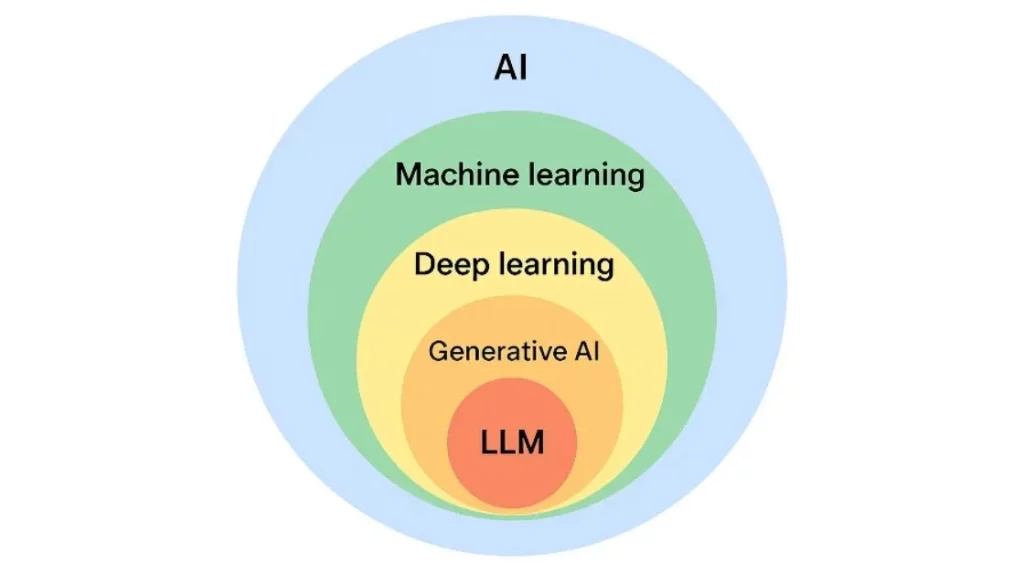
The more complex the technology, the more data is required, the longer the setup takes, and the higher the implementation cost. At the same time, the potential also grows: accuracy, automation, and scalability.
Real-world applications of LLMs
Customer service automation
LLM can be trained to understand customer language, requests, complaints, and clarifications, and respond as a live operator would. At the same time, the model is capable of processing thousands of dialogues simultaneously, reducing the load on support and improving service quality.
Bank of America uses a virtual assistant named Erica to help customers with questions about their accounts and transactions.
Marketing persona creation
LLM can analyze data on user behavior, responses to advertising, and content, and use this to create accurate marketing personas. The model identifies what is important to the customer, what triggers work, and what wording inspires trust.
For marketers, this is a way to personalize their strategy and reduce testing time.
You can “ask” LLM:
“Describe the profile of the user who most often buys X, and suggest a communication style that will convince them.”
Companies such as Coca-Cola and L’Oréal test advertising concepts using AI, reducing the cycle from idea to campaign.
Data analysis & visualization
LLM can be used not only for texts, but also for interpreting complex data.
They can explain reports in “human language”:
“Show me the key trends for Q3 and explain why profits fell in July.”
The model turns numbers and graphs into meaningful insights, helping managers make decisions faster.
For example, the analytics team can ask questions directly in natural language, without SQL queries, and get concise, accurate answers. To do this, you can use Tableau AI with Einstein Copilot.
Content personalization
LLM analyzes customer behavior, what they read, buy, and how they react to content, and creates personalized recommendations and texts.
The effect is evident in e-commerce and media: letters are adapted to the customer’s style, content on the website changes dynamically depending on interests, and advertising “senses” the user’s context.
Advanced developer tools
Almost every company has a team of developers. If not, this section isn’t for you.
For those who have decided to read on, we are sure that the cost of 1 hour of work for a middle developer and a senior developer won’t surprise you. So, most of these employees’ time is spent on basic routine processes, such as searching documentation, debugging obvious errors, writing tests, and refactoring (but you could just ask LLM to do the first steps on its own).
However, LLM tools don’t make a bad programmer a good one. If a person doesn’t understand what the code suggested by the model does, they’ll make a bunch of bugs. This tool works more like a competence booster. There are also some nuances that we cannot ignore: since LLMs are trained on public code, including code with vulnerabilities, the model may suggest a solution with SQL injection or XSS if it isn’t specifically configured for security. Accordingly, code review remains mandatory. If you have a strict NDA or work with sensitive data, you need on-premise solutions.
In this part of our article, we also emphasize one important point: LLMs don’t do all the work for specialists, but they reduce the workload significantly and allow you to engage in more creative and architectural aspects of development.
Building smarter chatbots
We have all tried regular chatbots on websites at some point. You know, the ones that say, “Press 1 if you want to learn about the product”, or “Press 2 if you want to return the product”. You type something, the bot doesn’t understand, and responds with standard questions. This part raises the question: why do we need chatbot development services?
LLM chatbots work differently: they understand the meaning of the request, even if it is formulated in a non-standard way, and generate a response based on available information, rather than a pre-written template. The customer receives a response in seconds, rather than waiting 20 minutes or several hours for an operator to become available. The ROI is obvious.
3 the most popular LLMs today
There are several key LLMs on the market today, each with its own characteristics and use cases. They vary in scale, data sources, and openness to business, but they all serve the same purpose: to help companies work with text and knowledge faster and more accurately.
GPT-4
The most famous model developed by OpenAI. Used by millions of companies for: automating communications (chatbots, support services), content creation, document analysis, and preparing marketing materials.
Consulting firm PwC implemented GPT-4 to automatically analyze legal documents and reduce audit time.
As a result, the company significantly saved employee time and increased the accuracy of data interpretation.
BERT
A model from Google that has become the basis for search algorithms and language understanding systems. BERT doesn’t generate text like GPT-4, but understands the meaning of what is written: it determines context, intent, and emotional tone.
BERT is used in Google search: it is thanks to it that the search engine “understands” what you mean, even if the query is not exact. In business, BERT is useful for analyzing reviews, tickets, questionnaires, and anywhere else where it is important to understand how the customer really feels.
LLaMA
This tool was developed by Meta (Facebook) and is primarily intended for corporate use and customization. The main advantage of LLaMA is its openness to configuration: companies can train it on their own data, creating private versions for specific tasks.
Hugging Face uses LLaMA to develop internal solutions and custom chatbots that work with corporate documents. This makes the model convenient for companies that need to store data locally and comply with confidentiality requirements.
Key facts: Generative AI vs LLM

How do companies achieve the data-driven decision-making process?
At Data Science UA we assist companies in extracting real value from unstructured data sources
Not all Generative AI tools rely on LLMs, but every LLM is a type of Generative AI
As we have already mentioned, generative AI is a broad concept. It encompasses all systems that create something new: images, music, code, text. But LLM is just one of its varieties, focused on working with language.
Example: Midjourney and DALL·E generate images, Suno generates music, GPT-4 or Claude generates text.
LLMs are designed primarily for text generation
LLM works with text at all levels: from simple letters to customers to complex analysis of corporate documents. Accordingly, businesses have more control over communication and the ability to standardize the tone and style of communication within the company.
Both Generative AI and LLM adoption are rapidly accelerating
From 2023 to 2025, the use of Generative AI grew sixfold, according to McKinsey.
While these technologies were initially tested in IT companies, they are now used by banks, insurance companies, pharmaceutical companies, media, e-commerce, and industry.
So, in essence, Generative AI vs LLM has become a new tool for scaling intellectual labor.
How do companies achieve the data-driven decision-making process?
At Data Science UA we assist companies in extracting real value from unstructured data sources
How to integrate Generative AI and LLMs into your workflow
Let’s imagine that you have decided that you need the technology. Now the main question is: how to implement the Gen AI vs LLM without disrupting existing processes, and where exactly this technology can bring benefits.
Our final piece of advice is: start with the top 5 most frequently asked questions, which account for 50-60% of inquiries. Create a detailed knowledge base for these scenarios and don’t rely on the bot to know everything: give it precise instructions on what to respond in each case. If the bot is unsure of the answer (confidence score below the threshold), it is better to transfer the call to an operator than to give the wrong answer.
Collect feedback and ask after the dialogue: “Did the bot help you solve the problem?” If there is negative feedback, you can easily analyze it and improve the responses to these scenarios.
After 2-3 months, when the basic scenarios are working steadily, expand to the next 5 most frequently asked questions.
How Data Science UA can support your business
Companies that successfully use AI most often start with a specific business task: automating customer service, accelerating content creation, generating visuals for marketing, or assisting the development team. First, they choose ready-made solutions, such as LLM via API or Generative AI tools, and then gradually customize them to their needs.
AI implementation experts, including the Data Science UA team, note that it is important to look at the effect on the business, not the technology itself.
In other words, large language models vs Generative AI aren’t “trendy toys”, but a tool that really helps people work faster and more efficiently. It does not replace the team, but takes on routine tasks: writing texts, creating visuals, and helping to analyze data.
When you approach implementation gradually, with a specific goal and understanding, the results are visible within a few weeks. You get a working tool that saves time, reduces the workload on employees, and allows the team to focus on what is really important.
As a result, AI vs LLM becomes both a technology and a part of the workflow that makes work easier and results more noticeable.
FAQ
Which industries benefit most from Generative AI and LLMs?
Sectors with large volumes of content, documents, customer interactions, or repetitive workflows benefit the most, such as retail, finance, healthcare, marketing, IT, and education. Anywhere companies need faster operations, lower costs, and fewer manual processes, Generative AI and LLMs show the strongest return.
Are LLMs more effective for conversational AI than other Generative AI models?
Yes. LLMs are specifically built to understand language, maintain context, and produce natural dialogue. They handle conversations more accurately than other Generative AI models, which focus on images, audio, or video rather than text-based reasoning.
How do I decide between Generative AI and LLMs for my project?
If your task involves conversation, text analysis, or working with documents, an LLM is usually the better fit. If the goal is to create visuals, audio, or other creative assets, standard Generative AI models make more sense. For mixed tasks, the best solution is often a combination of both.